Todd Hewitt
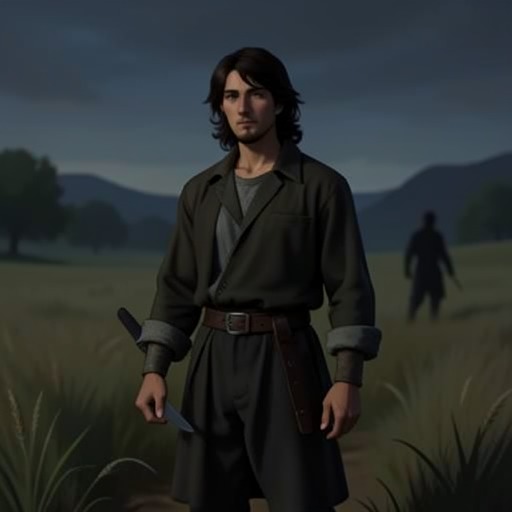
The Knife of Never Letting GoTodd Hewitt begins as a boy measuring his life against a deadline: in the thirteen-month calendar of New World, he believes he is a month from becoming a man. His journey dismantles the lessons attached to that milestone. As the youngest boy of Prentisstown, he is not simply growing older; he is approaching a town-defined threshold whose meaning he does not yet understand. By the end, Todd’s claim to adulthood rests less on the town’s calendar than on the choices he makes when violence and care pull him in opposite directions.
Identity and the Noise
Todd lives in Prentisstown, where the Noise of men makes thoughts audible and leaves little possibility of privacy. He regards this constant clamor as exhausting, and the swamp offers a rare partial respite. His trip there to pick apples is not really necessary: Ben could buy them at Mr Phelps’s store. But the errand gives Todd a reason to leave town, while the town’s rule that men should never be idle makes even a simple outing seem incompatible with manhood. His understanding of the world is already shaped by restrictions he has absorbed without yet knowing their full purpose.
The Noise also makes self-knowledge difficult. Returning from the swamp, Todd experiences his thoughts as churning and needs to stop to settle himself. Ben has taught him a technique: close his eyes and calmly remind himself who he is. Todd repeats his name, age, home, and the date on which he expects to become a man. The exercise gives him a temporary anchor, but its emphasis on identity becomes newly charged as the story reveals how much of his supposed world has been concealed from him. Noise is not merely a condition he endures; it is the medium through which he tries to understand himself and, later, the means by which he makes himself heard.
The Threshold That Becomes an Exile
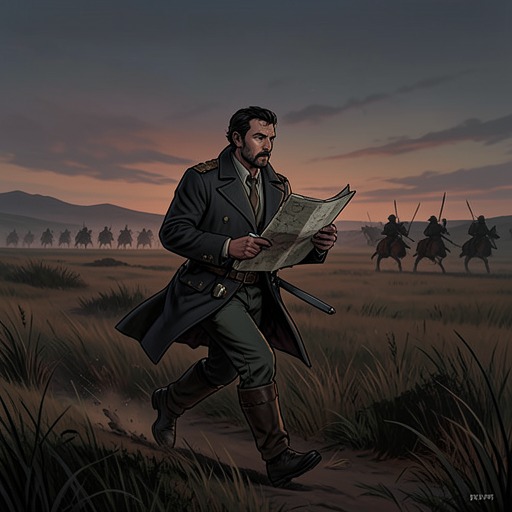
Todd’s expected passage into adulthood is interrupted when Ben and Cillian tell him he must leave Prentisstown. He initially cannot imagine another settlement on New World. That disbelief gives way to a rapid reappraisal: after finding Viola, he wonders whether the Noise germ might belong only to Prentisstown, and whether she might therefore be safe outside it. His reasoning is tentative, but it marks a crucial break with the certainty on which the town’s account of the world depends.
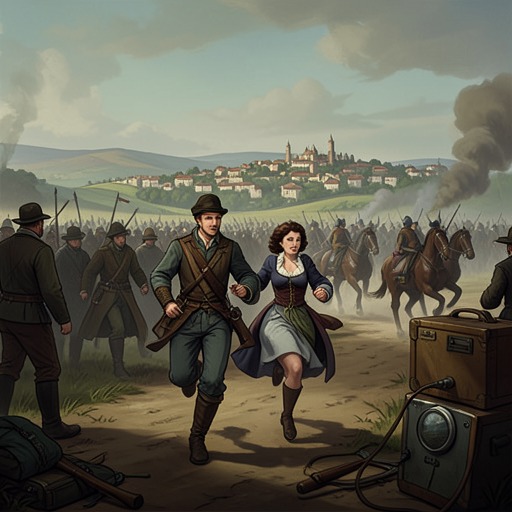
When Todd and Viola encounter Hildy, Todd tries to imagine a future in which Hildy could care for her and help her return to where she came from. He sees himself as carrying a germ that may endanger Viola and anyone else they meet, and concludes that he has nowhere to go either forward or back. His sense of isolation is not just geographical: he fears that the condition he carries makes him a threat to the very people he needs. The journey repeatedly tests this belief against the possibility of connection.
The coming-of-age countdown follows him into those encounters. When Matthew Lyle objects to him as a boy fleeing Prentisstown, Todd blurts out that he still has twenty-eight days. Hildy rejects the importance of his numbers in her settlement, while explaining that the law Matthew invokes is for men and Todd is not yet one. The exchange exposes the difference between calendar age and moral responsibility: Todd is still treated as a boy under one community’s categories, yet is already forced to act in circumstances that those categories cannot resolve.
Viola, Truth, and Responsibility
Todd first mistakes Viola for a Spackle, then recognizes that she is a girl. The discovery unsettles his understanding of the world, which has taught him that Prentisstown is the only settlement and supplied no place for someone like her. When she eventually gives him her name, their quiet exchange establishes a personal bond in a world where much about other people is involuntarily exposed through Noise. Todd has to learn Viola through her actions and words, not through the mental broadcast by which he is accustomed to reading men.
His hopes for her safety are complicated by what she tells him. Viola warns that the wider world must be alerted because Prentisstown is on the move, and that its plan has waited for the last boy to become a man. She also tells Todd that knowledge of the hidden history would put him in danger and points him toward his mother’s book. Todd confirms that he is the youngest boy and still has twenty-seven days before the age at which Prentisstown law calls him a man. His approaching birthday is thus linked not only to personal change but to the town’s larger plan, whose reach he is only beginning to understand.
Todd later considers whether the Noise germ may be confined to Prentisstown, because Viola has no Noise and does not appear sick. The hope matters precisely because he has already feared that he will infect her or others. It does not erase the uncertainty, but it allows him to imagine that she might be safe beyond the town. His care for Viola grows through such provisional judgments: he cannot offer certainty, yet he keeps trying to distinguish what he has been told from what he can observe.
Violence, Memory, and Choice
Todd’s account of his journey to Ben brings together the episodes that have transformed him: the crocodiles attacking Aaron, the flight through the swamp, Viola’s ship, pursuit by Mayor Prentiss, the bridge, Hildy and Tam, Farbranch, the singing creatures, and the confrontation with Mr Prentiss Jr in which Viola saves him. He also has to include the Spackle and what he did. The sequence is more than a report of travel. By opening his Noise to Ben, Todd gives his adoptive father access to the experiences and actions he has struggled to carry alone, including the act that has changed his understanding of himself.
That reckoning opens onto the concealed history of Prentisstown. Todd says that after the men killed the Spackle, they killed the town’s women and the men who tried to protect them. Ben qualifies the account: not every man took part, but many were swayed by Mayor Prentiss and Aaron, whose preaching cast what was hidden as evil. The revelation makes the violence surrounding Todd part of a history of collective wrongdoing, rather than an isolated danger posed by an enemy outside the town. It also clarifies why the stories used to define his community cannot be trusted.
Aaron gives Todd’s role in this history a further, coercive interpretation. He describes having viewed Viola’s silence as a sign of hidden evil and as an opportunity for a sacrifice, then frames Todd as someone destined to protect the helpless. Todd rejects the premise that Viola is helpless. When Aaron tells him that he has already fallen, Todd’s Noise flares red; later, as Aaron calls to him, Todd recognizes that he is going to use the response. These moments show him encountering the power and danger of his own Noise without establishing that violence is the only meaning it can have.
Self-Definition and the Ending
Todd’s clearest assertion of identity comes after he has been weakened and must still choose what to do. He tells the boy pursuing him that he is Todd Hewitt and is leaving him behind. He sends Manchee ahead with a burning stick, counts loudly to a hundred twice to prevent himself from hearing anyone’s words, and returns to the boat. The act is an escape, but it is also a separation from the boy he had been: Todd makes a decision under pressure rather than merely following the expectations of others. His declaration of selfhood echoes the calming exercise Ben taught him, now expressed not as private reassurance but as resolve.
At the end, Mayor Prentiss addresses him in a vast room bearing the repeated imagery of New World and its two moons. Todd’s hands and feet are bound to a chair. His first urgent concern is Viola’s whereabouts, and he struggles against his restraints as he demands to know what has been done with her. This ending reverses the movement of escape: Todd has crossed settlements and repeatedly resisted the roles assigned to him, but he is again physically under the control of the ruler whose plans helped set his journey in motion. The immediate outcome is captivity, with Viola’s condition unknown to him.
Todd’s arc joins a coming-of-age story to an escape and rescue narrative, but it refuses to treat adulthood as a simple reward for reaching thirteen. The town’s threshold is tied to a violent social order, and Todd’s experience exposes the gap between that order’s definition of manhood and the care, truthfulness, and self-command he must practice. His decisive return to Viola, even when he could have continued toward safety, gives his developing identity its most concrete measure: he is not defined only by the Noise he carries or the history he inherits, but by whom he chooses to protect.